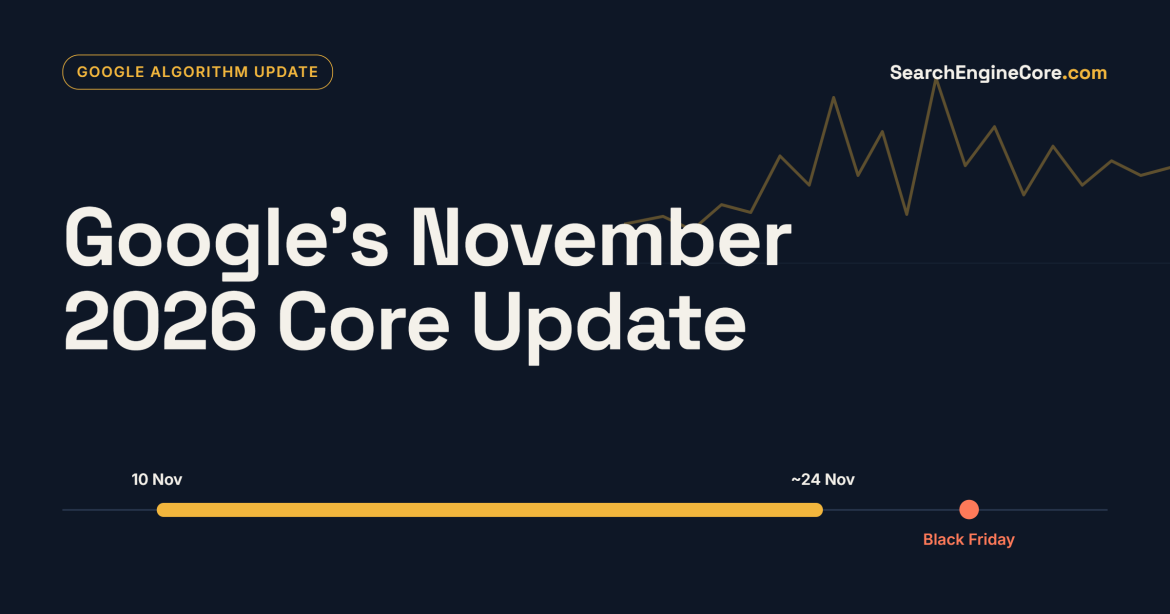
Google started rolling out its November 2026 core update on Tuesday, US time. Over here in India it landed close to midnight, which explains the pile of messages I woke up to on Wednesday.
Short version? It’s real, it’s global, and it could keep going until 24 November. That’s three days before Black Friday.
Google hasn’t said much, and we’re two days into a rollout that can take a fortnight. Any winners-and-losers list doing the rounds on LinkedIn right now is guesswork.
Quick facts
| Item | Detail |
| Update | Google November 2026 core update (broad core update) |
| Started | 10 November 2026, 10:06 am US Pacific (11:36 pm IST, 10 Nov / 5:06 am AEDT, 11 Nov) |
| Rollout | Up to two weeks, so it could run until around 24 November |
| Scope | Global, all languages |
| Google’s description | A regular update to better surface relevant, satisfying content from all types of sites |
| New guidance? | None. No Search Central blog post, no named targets |
| Where it sits | Third core update of 2026, after March and May |
| Measure from | A full week after rollout completes, compared with the week before 10 Nov |
What Google told us (hardly anything)
The Search Status Dashboard entry went up at 10:06 am Pacific on 10 November. One line. It says the update applies globally and to all languages, and that it might take up to two weeks.
Search Central’s LinkedIn post didn’t add much. Google called it a regular update meant to better surface relevant, satisfying content for searchers from all types of sites, which is pretty much what it says every time. Search Engine Journal even spotted that the dashboard wording is almost a copy of March’s.
There’s no blog post this time and no hint about what’s being targeted. So if you read that this update is “about” AI content, or affiliate sites, or anything else that specific, ask where that came from. It wasn’t Google.
One thing I’d keep in mind. Rank trackers were already jumpy on 8 and 9 November, before Google confirmed anything, and Search Engine Roundtable had readers saying it felt like a core update. Early testing? A separate tweak? Plain noise? I genuinely don’t know. It matters later, though, when you pick your baseline.
If you sell online, read this bit
Two weeks from 10 November takes you to roughly the 24th. Thanksgiving is on the 26th, Black Friday the 27th and Cyber Monday the 30th.
So category pages and gift guides could be bouncing around during the very fortnight they’re meant to pay for the year. You won’t get clean data on what happened until December.
I’m not predicting a traffic drop. Some stores will gain. The trouble is you won’t find out in time to react. My advice to store owners is boring but it works: give Shopping and Performance Max some budget headroom now, and watch impression share on your money keywords rather than refreshing a rank tracker every hour.
Don’t read too much into rank charts this week
Rankings see-saw during a rollout. A page drops five places on Wednesday, it’s back by Friday, then it slides again the following week. Judging the update from that is like calling a Test match after the first over.
The tools aren’t perfect either. PPC Land cited DemandSphere getting dodgy results in around 11% of its daily rank checks, while Nozzle flagged roughly 8% of results pages as unreliable. Some of that red on the volatility charts may not be real.
What I’m telling clients this week
Mostly, sit tight.
A drop during a core update isn’t a penalty, and Google has been saying so for years. Usually it means another page now answers the query better in Google’s view. Start deleting content or pushing a redesign mid-rollout and you’ll never untangle what caused what.
The genuinely useful job right now is saving a baseline. Google’s documentation says to wait at least a full week after the rollout ends, then compare Search Console data against a week before the update began. Strictly speaking that’s the week before 10 November. Because of the movement on the 8th and 9th, I’d use 1 to 7 November instead. Export it today and split it by page type (blog posts, category and product pages, service and location pages), since that’s where patterns tend to show.
Look at organic Search by itself, too. Core updates can shift Discover and featured snippets, so check those on their own and keep paid and social traffic out of the picture.
And keep publishing. If you’d already planned to beef up some thin pages, go ahead. Just don’t invent an emergency.
I have also checked my clients’ GSC accounts and haven’t found any major change in average position, impressions or clicks. I’m waiting for at least a week of data before I analyse the changes and which pages lost their positions and clicks.
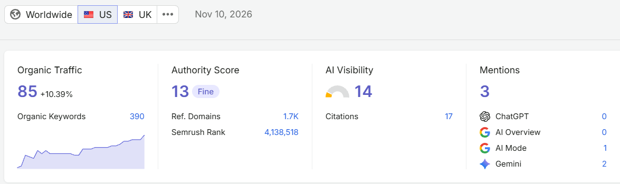
I also checked Semrush and Ahrefs and haven’t found anything suspicious for now.

Semrush overview for a client site on 10 November 2026, the day the rollout began
Ahrefs overview for a client site during the rollout
Once it’s done
When Google marks the rollout complete, give it a week and then pull your comparison. A single keyword dropping three spots tells you very little. A whole template sliding, every location page for example, tells you a lot.
If you’ve really lost ground, work through Google’s self-assessment questions, then spend more time studying the pages that overtook you than staring at your own. What have they got that you haven’t? That’s usually where the answer sits.
Recovery tends to be slow. Sites hit by one core update often don’t come back until a later one, and that might be months away.
That’s where things stand. Confirmed, global, still rolling out, and Google isn’t explaining it. Save your baseline, resist the urge to fiddle, and give ecommerce campaigns a paid safety net for Black Friday. I’ll put out a proper analysis once there’s clean data to look at.

Sanjeev Kumar is a digital marketing expert with over 14 years of experience in SEO, PPC, content marketing, and online growth strategies. He specializes in search engine optimization, AI-driven marketing, and digital strategy for businesses and agencies worldwide.