Credit where it’s due first. This post started with an interview Search Engine Journal published on 29 October 2026, in which Greg Jarboe spoke with HubSpot CMO Kipp Bodnar about what happened to HubSpot’s blog traffic and why the company stopped treating it as the main scoreboard. It’s one of the more candid conversations a big brand has had in public about AI search, and it lined up closely with something we’d been seeing on a much smaller website.
So this post does two things. It sets out what HubSpot reported, fairly and with the caveats that belong next to it. Then it puts our own numbers beside it, from a three-month-old local business site, with the screenshots so you can check them yourself.
What HubSpot reported
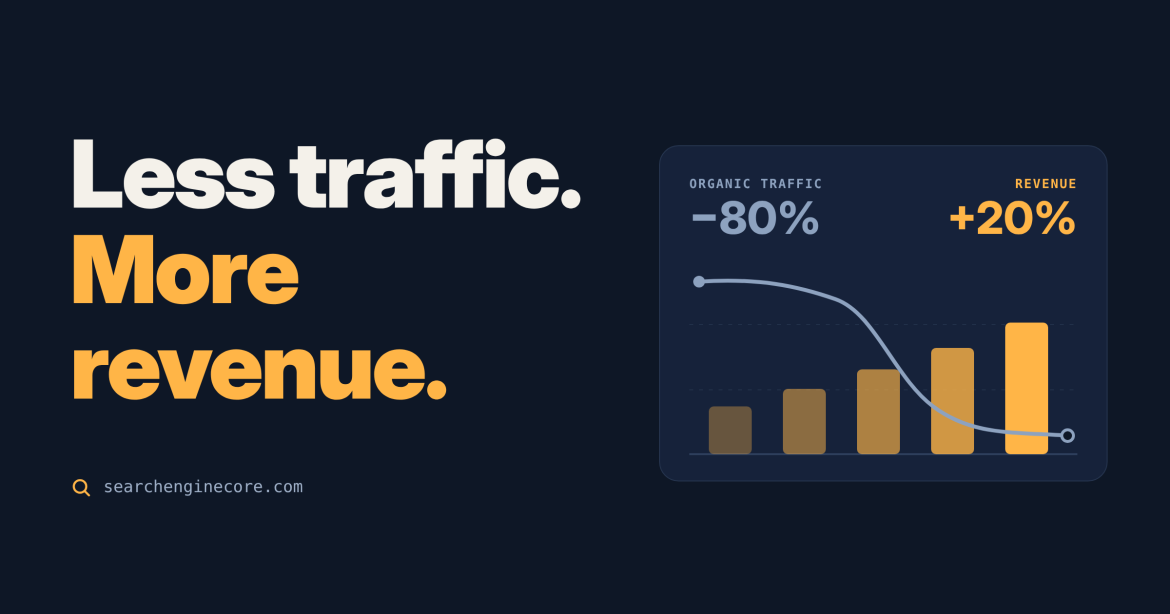
At its peak, HubSpot’s blog drew more than 20 million organic visits a month. As Google’s AI Overviews and chat assistants started answering questions directly, it lost roughly 80% of that. Revenue still grew close to 20% in 2025. Here are the figures Bodnar shared, as he stated them:
| Metric | As reported by HubSpot |
| Peak organic blog traffic | 20 million+ visits a month |
| Organic traffic lost | About 80% |
| Worst single stretch | Close to 5 million visits lost in 30 days after AI Overviews rolled out |
| Revenue growth, 2025 | Close to 20% |
| Share of content leads from the blog today | About 10% (the other ~90% from newer channels) |
| Conversion rate of AI-referred visitors | Roughly 3x traditional search |
| Qualified leads from AI answers | Up 1,850%, Q1 2025 to Q1 2026 |
| Deal cycle for AI-referred buyers | About half as long |
| Sales meetings booked via website chat | 10,000+ a quarter by Q4 2025 |
Source: Kipp Bodnar, interviewed by Greg Jarboe, Search Engine Journal, 29 October 2026.
Why the traffic loss didn’t sink the business
Bodnar was open about the fact that a lot of the lost traffic was never going to buy anything. Some posts had been written to catch volume on topics like famous quotes or how to type the shrug emoji. When Google began answering those itself, the visitors left, and very few potential customers left with them.
HubSpot had also spent around five years building audiences outside search. It bought The Hustle newsletter in 2021, started a podcast network that year, added a creator programme in 2022 and a YouTube network in 2023. It pruned thousands of old blog posts too. By the time AI answers arrived, the blog was no longer carrying the lead pipeline.
What changed most was the scoreboard:
| What HubSpot used to watch | What it watches now |
| Organic sessions | Revenue per visit |
| Keyword rankings | AI share of voice (mentions and citations) |
| Blog-driven leads | Content-influenced pipeline |
| Last-click attribution | Sales notes when prospects say an AI tool recommended HubSpot |
Reading it fairly
The traffic drop is real and widely visible in third-party SEO tools. The point about low-intent traffic holds up too. Still, a few things are worth keeping in mind before anyone copies the conclusions into a client report.
The figures are self-reported. Bodnar deserves credit for being upfront here. When pressed, he said some of the grades he’d used in talks were his own assessment, and he described the link between AI visibility and revenue as correlative. In his words, “Attribution is imperfect.” Growth of 1,850% will also have started from a small base.
There is commercial context. The interview accompanies Loop, a new book by Bodnar and HubSpot’s Kieran Flanagan, and HubSpot sells AEO and AI tools of its own. That doesn’t make the story wrong. It’s just context a reader should have.
Revenue has many drivers. HubSpot is a listed software company with a large sales team and an existing customer base. Revenue rising while blog traffic fell shows the blog wasn’t holding the business up. It doesn’t show that losing traffic is harmless for everyone.
Most businesses aren’t HubSpot. It had the budget and five years’ head start to build channels Google can’t touch. A local trade business or a new ecommerce store whose leads mostly come from organic search would feel an 80% drop very quickly.
The part that does transfer to almost any business is simpler: a lot of the traffic SEO reports celebrate was never going to turn into customers.
Our case: a new Melbourne removalist site
I have a client in Australia, a removalist based in Melbourne’s western suburbs. When we took on the SEO, the website was brand new, with no domain history, almost no backlinks and early rendering problems that stopped Google from seeing the content properly.
Competing for broad terms like “removalists Melbourne” would have meant a long, slow climb against established companies. So we went the other way. Every page we built targeted a specific, lower-volume search with clear buying intent: a particular suburb, a particular kind of move, the sort of query someone types when they already have a date and need a quote. We didn’t chase blog traffic.
The numbers (1 August to 29 October 2026)
All figures below are filtered to visitors in Australia, because the business only serves Melbourne. More than 70% of the site’s total sessions came from outside Australia, mostly bots and people who could never become customers. Leaving them in would make the traffic look bigger and the lead rate look worse, and neither would be honest.
| Metric | Figure | Source |
| Sessions from Australia | 198 | GA4 |
| Organic Search sessions | 133 (67%), about 44 a month | GA4 |
| AI Assistant sessions | 33 (17%) | GA4 custom channel |
| Direct / Referral sessions | 23 / 8 | GA4 |
| New leads (all channels) | 24 | GA4 lead acquisition |
| from Organic Search | 14 (58%) | GA4, first-user channel |
| from AI Assistants | 7 (29%) | GA4, first-user channel |
| from Direct | 3 (13%) | GA4, first-user channel |
| Phone number clicks | 10 clicks from 8 users | GA4 |
| Google clicks (Australia) | 95 | Search Console |
| Google impressions (Australia) | 74,100 | Search Console |
| Average position | 33.3 | Search Console |
| Impressions in Google’s AI features | 456 | Search Console (beta report) |
| Indexed pages | 87 | Search Console |

GA4 traffic acquisition, Australia only: 198 sessions, 133 from Organic Search and 33 from AI assistants.
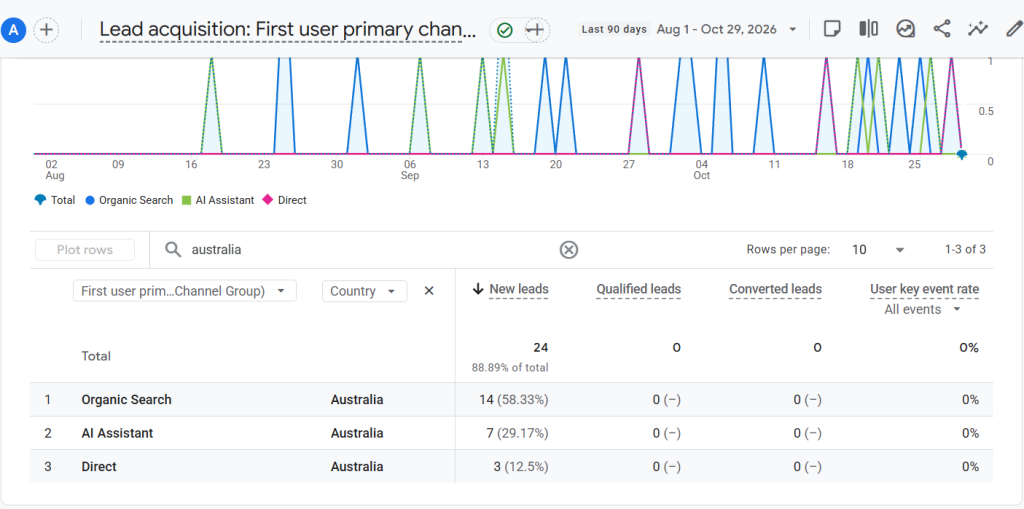
GA4 lead acquisition, Australia only: 24 new leads, 14 from Organic Search, 7 from AI assistants and 3 Direct.
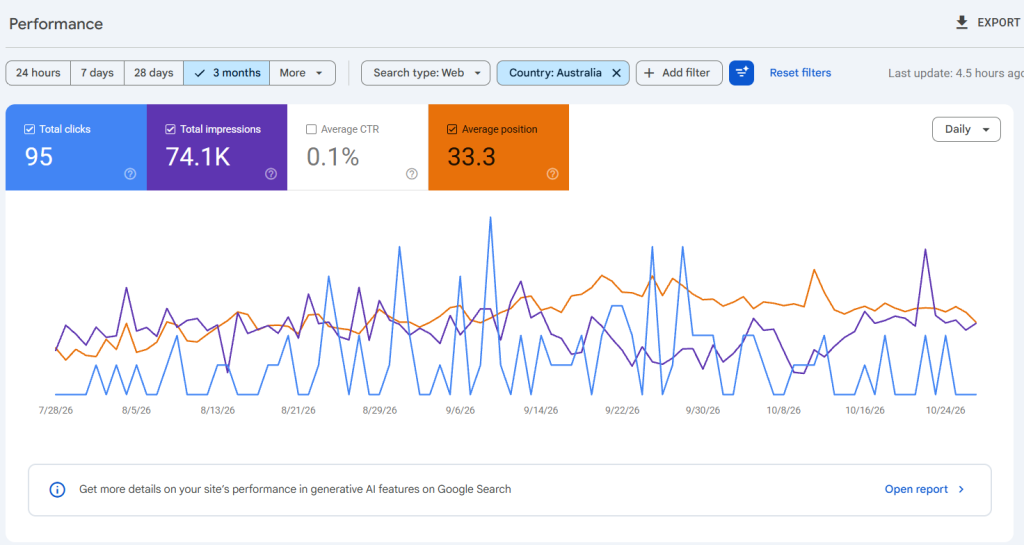
Google Search Console, Australia, last 3 months: 95 clicks, 74.1K impressions, average position 33.3.
What the data says
On a traffic chart, about 44 organic visits a month looks like nothing. Most SEO dashboards would flag it as a problem.
But 24 people in Australia submitted an enquiry over those three months, out of 127 Australian users. A further eight tapped the phone number. Organic search produced 14 of those leads from 133 sessions, which works out to roughly one lead for every ten organic visits. For a site with no history, that’s a strong result, and it comes from pages built around one specific job each, so the person landing on them is usually already looking to book.
There are limits to what these numbers prove, and we’d rather say so than have someone else point it out:
More than half the Google clicks were branded. Of the clicks GA4 attributes to individual Google queries, 32 out of 54 (59%) were people searching “ring a mover” by name. Those searchers already knew the business, through its Google Business Profile, word of mouth, an AI recommendation or the van on the street. SEO helps them find the right page, but it didn’t create that demand on its own. The other 22 clicks came from suburb and service searches, which is where the targeted pages are doing their job.
Most of the keywords aren’t ranking well yet. An average position of 33.3 and a 0.1% click-through rate tell you the site appears on page three or four for most of its 74,100 impressions. The best non-branded result so far is “removalists williams landing” at an average position of 6.4, in the suburb where the business is based. Several suburb terms sit between positions 10 and 20, close enough to earn the occasional click. The broad Melbourne-wide terms are still a long way back.
Leads aren’t sales. GA4 counts enquiries, and that’s what we’re reporting. Qualified and converted leads aren’t tracked in GA4 for this site, so we’re not putting a figure on booked jobs or revenue. What I can say is that the client tells me these enquiries are turning into paid work, which is a good place to be for a website that’s only a few months old.
The early leads were mostly smaller jobs. Single items, small flat moves around the suburbs. That’s normal for a new site, since Google trusts it with narrower searches first and bigger jobs tend to follow as authority builds. Turning enquiries into booked work is the client’s side of the process. Getting qualified people to ask for a quote is ours.
The AI search signal
One number connects directly to the HubSpot story. Thirty-three of the 198 Australian sessions, about 17%, came from AI assistants such as ChatGPT, Perplexity and Gemini. On a three to four month old local business site, that’s more than we expected. Search Console also shows 456 impressions in Google’s generative AI features over the same period.
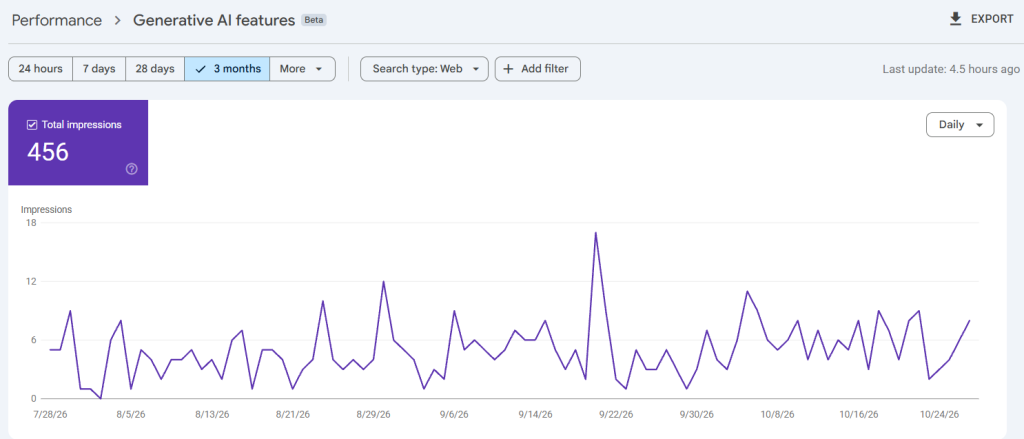
Search Console’s generative AI features report (beta): 456 impressions over three months.
More interesting is what those visitors did. AI assistants produced 7 of the 24 leads from just 33 sessions, a little over one lead for every five visits. Organic search managed about one in ten. That’s roughly double, which is in the same direction as HubSpot’s claim that AI-referred visitors convert about three times better.
We’d be careful with that comparison. Seven leads is a tiny sample, and GA4 credits leads to the channel that first brought each user in, while the session counts use the channel of each visit, so the two figures don’t line up perfectly. It’s a signal worth watching, not a benchmark. It’s also why we track AI assistants as a separate channel from day one rather than letting them disappear into “referral”.
Where the Google clicks came from
This is what the query data looks like. Apart from the branded searches, every click came from a search naming a suburb or a specific service, often with only a few dozen to a couple of hundred impressions over three months.
| Google query | Clicks | Impressions | Avg position |
| ring a mover (branded) | 32 | 263 | 3.5 |
| removalists williams landing | 3 | 245 | 6.4 |
| house movers laverton | 2 | 78 | 10.8 |
| removalists truganina | 2 | 220 | 14.3 |
| piano movers melbourne | 2 | 719 | 29.7 |
| removalists wyndham vale | 1 | 117 | 14.1 |
| house movers werribee | 1 | 101 | 17.7 |
| furniture removalist truganina | 1 | 24 | 20.8 |
| man with a van werribee | 1 | 10 | 23.0 |
| interstate removalists melbourne | 1 | 664 | 29.1 |
Top Google queries, 1 August to 29 October 2026 (Search Console data in GA4). Branded searches made up 32 of 54 query-level clicks.
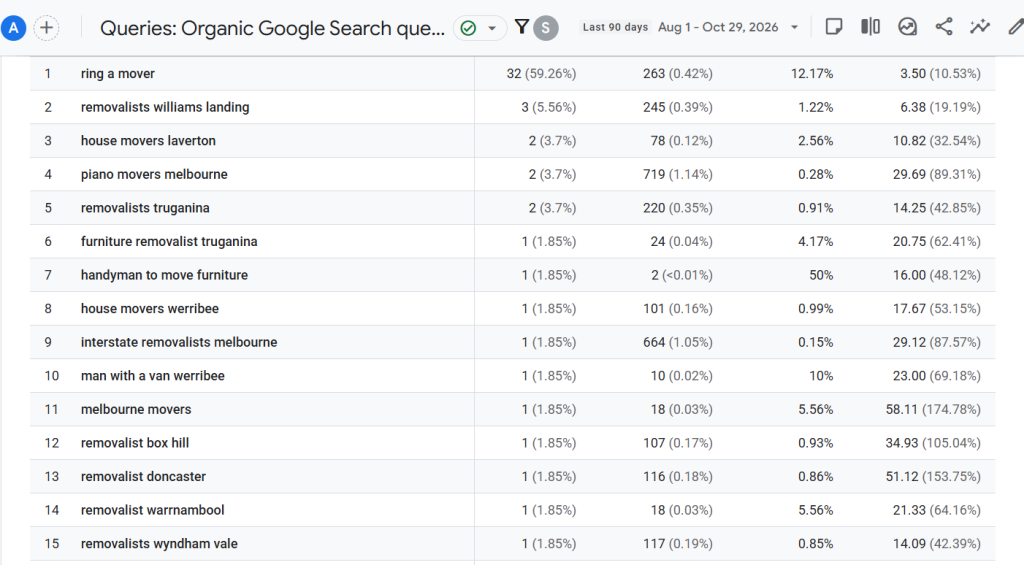
Search Console query report in GA4: clicks, impressions, CTR and average position by query.
What any business can take from this
Sort your pages by leads, not visits. In GA4, pull your landing pages for the past 12 months with your key events beside them. Pages with plenty of sessions and no enquiries in a year are the ones AI answers will take first. Prune them, merge them, or rewrite them for someone who might actually buy.
Target the search someone types when they’re ready. “Removalists Melbourne” is crowded and vague. A suburb plus a type of move is quiet, and the person searching it has a date in mind. That trade-off is why a site with 44 organic visits a month can still produce steady enquiries.
Put a business number at the top of every report. Leads per organic session, cost per lead, or booked jobs if the client will share them. Sessions can stay in the report, lower down.
Give AI traffic its own channel in GA4. By default, visits from ChatGPT and similar tools land in “referral” or “direct”. A custom channel group takes ten minutes to set up. Adding “AI assistant” as an option on your “How did you hear about us?” field helps too.
Filter to the market you actually serve. If a business only works in one city or country, report on that audience. It makes traffic look smaller and makes everything else more accurate.
Write for long questions. Bodnar says prompts in AI tools now often run 40 to 100 words, with the person describing their whole situation. Pages that answer one specific situation clearly tend to get picked up. Thin keyword pages don’t.
Where this leaves SEO
HubSpot and a small Melbourne removalist have very little in common, yet the data from both points in the same direction. A rising traffic graph and a growing business are two separate things, and AI search is making the gap between them easier to see.
If your organic sessions are falling, start by asking which of those visits ever led to an enquiry. Sometimes you’ll find you’ve lost very little that mattered. Sometimes you’ll find real work to do. Either way, it’s better to know before a client or a boss asks.
Frequently asked questions
How much traffic did HubSpot lose?
About 80% of its blog’s organic traffic, from a peak of more than 20 million visits a month, according to CMO Kipp Bodnar. Close to 5 million visits went in a single 30-day period after Google rolled out AI Overviews.
Why did HubSpot’s revenue keep growing?
Much of the lost traffic had no buying intent, and HubSpot had already built newsletter, podcast, YouTube and creator channels that now produce around 90% of its content leads. Its sales team and existing customers also drive revenue independently of the blog.
Is it worth targeting low-volume keywords?
For service businesses, often yes. Lower-volume searches with clear intent tend to be easier to rank for and convert far better. On the Ring A Mover site, around 44 organic visits a month produced 14 leads over three months from Australian visitors.
Does traffic from AI assistants convert better?
HubSpot reports that AI-referred visitors convert at about three times the rate of traditional search. That’s one company’s own figure, so check it against your own GA4 data by setting up a separate AI channel.
What should I report instead of organic traffic?
Leads or revenue per visit, conversion rate by channel, AI mentions and citations for your key prompts, and leads by landing page. Keep traffic in the report, just not as the headline.

Sanjeev Kumar is a digital marketing expert with over 14 years of experience in SEO, PPC, content marketing, and online growth strategies. He specializes in search engine optimization, AI-driven marketing, and digital strategy for businesses and agencies worldwide.