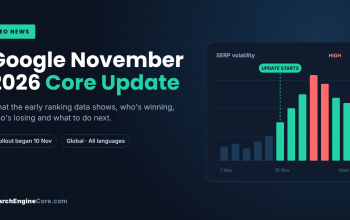
On 24 November 2026, Google wrapped up its November core update. Fifty-nine minutes later it posted something I’ve never seen in 14 years of doing this work: a notice that the next core update was coming. No rollout. No start date. Just a heads-up.
That’s new. Google has given advance notice of other kinds of search changes before, but never a core update. For years it told us core updates couldn’t be announced in advance. Now there’s an entry on the Search Status Dashboard with the status “Preannounced” sitting there for everyone to read.
I’ve checked the original sources, Google’s own documentation, and what the people who actually track these updates are saying. Some of the coverage is getting ahead of itself, so let’s separate what’s confirmed from what’s guesswork.
Is it real? Yes, and here is what Google actually said
I verified this against Google’s Search Status Dashboard directly, not just the news write-ups. The incident is logged at 07:02 Pacific time on 24 November 2026, and its status is “Preannounced”. Google’s wording on the dashboard:
“Preannounced the December 2026 core update, which focuses on multiple improvements to how our systems understand and rank relevant content (including for longer and more complex questions), as well as improving personalized results for people who have personalization turned on. This core update applies to all locations and languages where Google Search is available, and our guidance about general core updates applies. This update is scheduled to be released in December 2026.”
A Google spokesperson told Barry Schwartz at Search Engine Roundtable that the update is “not imminent” and that Google will post again when the rollout actually starts. One oddity: the dashboard briefly displayed it as an active incident, which confused a few people. Google confirmed to Barry three times that nothing is live yet.
| Item | What we know (as of 27 November 2026) |
| Update name | December 2026 core update |
| Announced | 24 November 2026, on the Google Search Status Dashboard, about an hour after the November 2026 core update was marked complete |
| Status | Preannounced. Not live. Google says it is “not imminent” |
| Release window | “Scheduled to be released in December 2026”. No start date given |
| Scope | All locations and languages where Google Search is available |
| Focus areas | Understanding and ranking relevant content, longer and more complex questions, personalised results for users with personalisation turned on |
| Why it was preannounced | UK CMA fair ranking conduct requirement for Google (compliance due 17 December 2026) |
Why Google is suddenly telling us in advance
This isn’t Google deciding to be nice. It’s regulation.
The UK’s Competition and Markets Authority designated Google as having strategic market status in general search, and on 17 June 2026 it imposed a fair ranking conduct requirement. Google has to comply by 17 December 2026. Under that requirement, Google must give at least 30 business days’ notice for changes where publishers could act to reduce the impact on their rankings, and at least 15 business days for other changes that could significantly move rankings.
Google has published a new “stay informed” page explaining when it gives notice: actionable policy changes (content policies, technical guidelines, eligibility rules) and significant ranking changes such as core updates. It also launched a Search ranking hub with a principles page and a structured way to send feedback on specific updates through Search Console.
Remember, in December 2025 John Mueller said pre-announcing quality changes for a fixed date wasn’t really possible. Barry’s reaction this week summed it up neatly: “well I guess now it is possible.”
Sanjeev’s take: The interesting bit for anyone outside the UK is that this is a global update with a UK-driven notice. Google isn’t going to run two separate announcement systems. So Australian, Indian and US site owners get the same early warning UK publishers do. Regulation in one market quietly changed the rules for everyone. Don’t expect that to stop at core updates either, the 30-day notice for policy changes could be even more useful in practice.
When will it actually roll out? My read
Google hasn’t said. Anyone giving you a firm date is guessing.
But here’s some arithmetic worth knowing. The 15-business-day minimum isn’t legally binding until 17 December, so Google doesn’t technically have to follow it yet. If it does follow it voluntarily, counting 15 UK business days from 24 November takes you to around 15 December. Put that next to the 17 December compliance date and the “not imminent” comment, and a mid-to-late December rollout looks more likely than an early one.
That is my inference, not anything Google has confirmed. Treat it as a planning assumption, not a fact.
Sanjeev’s take: If you run an ecommerce store, this is the part that matters. A mid-December rollout lands right in peak holiday trading, and past December updates have been long ones. The December 2025 update ran 18 days, from 11 to 29 December. I’d plan for volatility through Christmas and into early January, and I wouldn’t schedule any big site migrations or template changes in that window.
What the update is focused on, and what I think it means
1. Ranking relevant content
This is standard core update language. Every core update claims to improve relevance. On its own, it tells you nothing you can act on.
2. Longer and more complex questions
This is the part I’d pay attention to. Longer, conversational queries are exactly how people use AI Mode and AI Overviews. On the same day, Google published a document explaining how its generative AI features pick links: they draw on top-ranked organic results, may run related searches behind the scenes (query fan-out), and then link to the sources that back up the answer. Google states those features are integrated directly with its core ranking and quality systems.
Put those two together and my read is simple. Pages that genuinely answer a detailed, multi-part question, with clear sourcing and a real author behind them, should be in a better spot. Thin pages written for a single short keyword probably won’t be.
3. Personalised results
Google specifically mentions people who have personalisation turned on. We don’t know the mechanics yet, and I’m not going to pretend we do.
Barry Schwartz flagged this on Search Engine Land too, noting it’s unusual for Google to mention personalisation in connection with a core update at all. I agree. Core updates have always been described as broad changes to how content is assessed for everyone. Tying one to personalised results is a different kind of statement, and it’s the detail I’ll be watching most closely once the rollout starts.
Sanjeev’s take: Here’s the practical problem nobody’s talking about enough. The more personalised results get, the less your rank tracker reflects reality. Two users searching the same phrase may see different pages. After this update I’ll be leaning even harder on Search Console clicks and impressions, and on conversions in GA4, and treating third-party position data as a rough indicator only. If you report to clients on average position alone, now’s a good time to change that.
What industry experts are saying
Most of the commentary so far is on X and LinkedIn, and there’s a fair amount of noise. These are the voices worth listening to, because they track update impact with real data.
Barry Schwartz (Search Engine Roundtable) broke the story and flagged the dashboard glitch. He’s also pointed out that Google’s own statements haven’t always matched what we see in the data, which is a healthy reminder to stay sceptical.
Glenn Gabe (G-Squared Interactive) dated the real impact of the November update to 13 November, three days after rollout began, and relied on Search Console because third-party tools were giving inconsistent readings early on. He has also warned that tremors and reversals can keep happening after an update is marked complete.
Lily Ray (Algorythmic and Amsive) shared data on LinkedIn showing subfolders and subdomains on six sites dropping hard since November began. Each one used a single template repeated across thousands of pages, think pages per area code or per “X vs Y” comparison, often targeting searches unrelated to the site’s core business. Blog and resource sections fell while main product and brand pages held steady, and citations in AI Overviews and AI Mode dropped too. She also highlighted the trust signals in Google’s new AI document: clear sourcing, authors, and not faking freshness with artificial date changes.
Marie Haynes expects big ranking changes soon. She also noted that a click spike in Search Console between 31 October and 2 November was bot traffic, so leave those days out of any baseline.
Harpreet Chatha pushed back on the trend of telling everyone to post on LinkedIn for AI visibility, pointing to Ahrefs data showing LinkedIn’s organic traffic from top-three rankings sliding since the November update. His point: when a platform gets spammed for SEO, Google tends to respond, and being cited doesn’t pay the bills.
Matt G. Southern (Search Engine Journal) recommended adding the Search Status Dashboard RSS feed to your monitoring so you see preannouncements before rankings move. Simple, and worth doing today.
Separately, Peec AI’s David Konitzny tracked how often the first inline link in an AI Overview appears in the top third of the answer. By his numbers it fell from 76.8% on 21 September to 51.8% on 20 November. That’s one company’s dataset and Google hasn’t commented, but it fits a pattern a lot of us are seeing: AI visibility is getting harder to earn, not easier.
The reality check
A preannouncement is not a cheat sheet. Google has told us roughly when and roughly what. It hasn’t told us anything you can specifically optimise for, and it says its normal core update guidance applies. Anyone selling a “December core update prep package” this week is selling the same advice they sold last month.
The bigger risk right now is self-inflicted. November’s data isn’t settled yet. The first full week after that rollout ends on 1 December, and Google itself recommends waiting at least a week of post-rollout data before drawing conclusions. If you start rewriting pages now because you’re nervous about December, you’ll muddy both datasets and won’t know what caused what.
Sanjeev’s take: In my experience the sites that get hurt worst in a core update are rarely hurt by one thing the update “targeted”. They’ve usually been carrying weak sections for years: templated pages nobody reads, blog posts written for keywords instead of people, author pages that say nothing. The update just stops tolerating it. Three weeks of notice won’t fix a three-year problem, but it’s enough time to find it and stop making it worse.
What I’m doing for clients before the rollout
Nothing dramatic. That’s deliberate.
- Lock in a clean November baseline. Compare 25 November to 1 December against a pre-rollout week like 3 to 9 November in Search Console. For retail sites, that week includes Black Friday and Cyber Monday, so also compare against the same holiday period last year.
- Annotate everything. Mark the November completion date and the December start date (when it comes) in GA4 and your reporting. Two core updates in about six weeks will overlap in the data.
- Audit templated and programmatic pages. If a site has thousands of near-identical pages chasing searches unrelated to what the business sells, that’s the pattern Lily Ray’s data flagged. Decide whether they earn their place.
- Tighten trust signals. Real author bios, a proper About page, clear sources on factual claims. No artificial date refreshes.
- Check content against longer questions. Look at Search Console for longer queries already bringing impressions. Does the page actually answer the full question, or just the first half of it?
- Freeze risky changes over the holidays. No migrations, URL restructures or template overhauls between mid-December and early January unless they’re urgent.
- Subscribe to the dashboard feed. The Search Status Dashboard has an RSS/Atom feed. Add it so you know the day the rollout starts.
And if the rollout does hit a site unfairly, there’s now a feedback route. Verified owners can submit feedback in Search Console for updates listed on the dashboard, tagged with the update name. Google is clear that it won’t make manual, URL-by-URL ranking changes from that feedback, so treat it as a way to flag systemic problems, not an appeal.
FAQ
Is the December 2026 core update live?
No. As of 27 November 2026 it’s preannounced only. Google will post on the Search Status Dashboard when the rollout begins.
When will it start?
Some time in December 2026. Google hasn’t given a date and has said it’s not imminent. Mid-to-late December is my best guess, for the reasons above, but it’s a guess.
Does it affect sites outside the UK?
Yes. The notice is driven by UK regulation, but the update itself applies to all locations and languages where Google Search is available.
Should I change my content now?
Fix genuine quality problems you already know about. Don’t make reactive changes based on fear of an update nobody has seen yet, and don’t touch pages that are performing well.
How is this different from the November 2026 core update?
November was described as a regular update and ran from 10 to 24 November. December is the first core update Google has announced in advance, and the first in a while where Google has named specific focus areas: complex questions and personalisation.
I’ll update this post when the rollout starts and again once there’s enough data to see who moved. If you want a second pair of eyes on your site before December, get in touch through SearchEngineCore.com.

Sanjeev Kumar is a digital marketing expert with over 14 years of experience in SEO, PPC, content marketing, and online growth strategies. He specializes in search engine optimization, AI-driven marketing, and digital strategy for businesses and agencies worldwide.