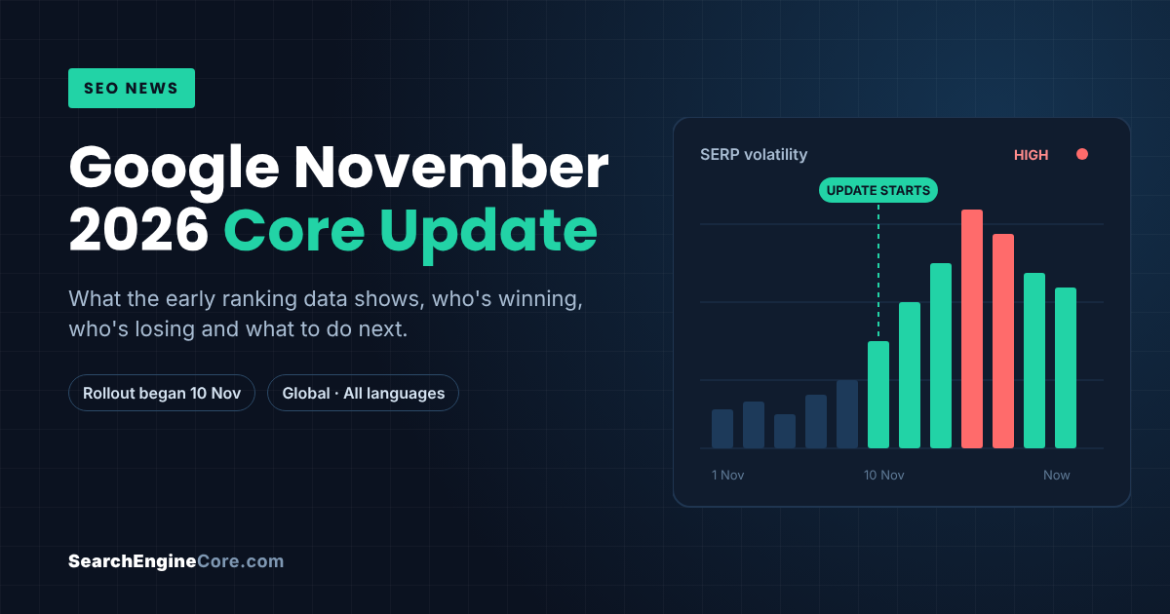
Google began rolling out its November 2026 core update on 10 November at 10:06 am Pacific Time, which works out to 11:36 pm IST for readers based in India. This is the third core update released during 2026, following the March and May updates, and it is also the first broad update since the May rollout concluded on 2 June. As a result, more than five months passed between the two core updates, making it the longest gap recorded so far this year.
As is typical with Google, the announcement itself was brief. An entry posted on the Search Status Dashboard confirmed that the update applies globally across all languages and that the rollout may require up to two weeks to complete. In a LinkedIn post from Search Central, Google described it as a regular update intended to surface “relevant, satisfying content for searchers from all types of sites.” However, Google did not publish an accompanying blog post or identify any specific targets and, unusually, the update was not announced on X at all.
At the time of writing (23 November), the dashboard had not yet marked the rollout as complete.
The Timing Creates Difficulties for E-commerce Businesses
For e-commerce businesses, much of the potential risk comes down to the timing of this rollout. If Google uses the full 14-day window, the rollout will conclude on 24 November. Thanksgiving follows on 26 November, with Black Friday on 27 November and Cyber Monday on 30 November. Google’s core update documentation recommends waiting at least one week after a rollout is completed before comparing Search Console data, which means clean post-update data will not be available until approximately 1 December.
To put things simply, many online retailers will be evaluating their largest sales week of the year based on rankings that are still stabilising. The good news is that both of this year’s previous core updates concluded ahead of schedule. The March rollout took just over 12 days, while the May rollout concluded in slightly under 12 days.
Ranking Movement During the Initial Week
Compared with many recent core updates, early discussion surrounding the November update appeared noticeably softer than usual. According to Search Engine Roundtable, most of the movement began around Saturday, 14 November, roughly three to four days after launch. Aggregate volatility tools also appeared somewhat calmer than during a typical core update, although part of this may be explained by tracking tools being blocked from collecting data.
This particular issue deserves considerably more attention than it currently receives. Rank tracking has been unreliable since September. PPC Land reported that DemandSphere recorded spurious results on roughly 11% of its daily rank checks, while Nozzle classified 8% of results pages as poisoned. In addition, Search Console reporting has been lagging behind. Therefore, if your rank-tracking tool shows something unusual this month, it is worth verifying the data through more than one source before reacting.
Anecdotal reports across forums and social media point to a wide range of outcomes. Some site owners have seen click-through rates increase fivefold on pages that normally receive very little traffic, whereas others have reported weekly traffic declines of more than 20%. One YMYL site owner noted that the top 20 results for their search terms had become entirely informational, with commercial pages pushed aside by older articles. Additionally, several e-commerce businesses reported that their category pages had been replaced by blog posts and filter pages.
AI-generated content is also worth mentioning. Glenn Gabe shared two domains that experienced significant declines after scaling up their use of AI-generated content. While these two examples alone are insufficient to indicate a trend, they are consistent with what has been observed in previous updates.
Initial Data: Brands Are Rising & Lead Generation Sites Are Dropping
At present, SISTRIX provides the most useful data related to this update. Its UK data shows changes from 13 November onwards, with significant overall movement, including among large and well-established domains. At the same time, as of 20 November, no individual industry had experienced heavier losses than the others.
Winners tend to include official websites of brands and named entities, along with original data sources. Examples include:
- A charity organisation’s own website
- Product manufacturers’ websites
- Historical record archives
Losers include:
- Sites providing language support and word-reference content
- Lead generation sites in finance, health and law that rely on informational content to attract visitors and encourage conversions through forms or sales
Within a single week, several sites in this latter group lost between 44% and 59% of their visibility.
Germany appears to be following a similar pattern. Rheinwunder’s preliminary analysis of 134 German domains, based on SISTRIX data collected up to 18 November, found that 36 domains gained at least 5%, 23 domains lost at least 5% and the remaining 75 held steady. Government and public sector sites rose by a median of 5.5%, whereas price comparison sites declined by 4.6% and forums, user-generated content and review platforms dropped by 3.3%.
Additionally, this analysis highlighted an important point that is worth repeating. Volatility in Germany began increasing on 1 November, nine days before the official start of the update, and sites such as Reddit and Trustpilot had already declined sharply before 10 November. Consequently, if your traffic decreased in early November, you should not automatically assume the core update is responsible.
None of this is entirely new. SISTRIX’s analysis of the March update found considerably more losers than winners, the majority being sites that could easily be replaced by a competitor, while official sources and well-known brands gained visibility.
Has Google Changed Its Guidance?
Not specifically for this update. However, in early October Google quietly added a definition of “main content”, along with a warning about fabricated author profiles, to its helpful content guidance, a change Marie Haynes was quick to highlight. Google has not connected these edits to the November update. Nevertheless, if your website invents expert bylines or surrounds thin answers with paragraphs of filler content, now would be a sensible time to address it.
What Should You Do Right Now?
Realistically, very little at this stage. According to Google, small declines do not require drastic action, and ranking fluctuations during a rollout tend to arrive in waves. As a result, a page that loses positions on Tuesday may well recover by Friday.
Once the dashboard confirms the update is complete, wait one week. After that, compare Search Console data from before 10 November with the week following completion, focusing on individual pages and queries rather than total clicks alone. In particular, check whether the losses were concentrated on informational pages built to generate leads, on category pages or on content that was produced quickly and at scale.
If the decline is substantial and persists, work through Google’s self-assessment questions for the website as a whole rather than evaluating it page by page. It is worth asking honestly whether anyone would miss your content if it disappeared tomorrow. Google has been clear that recovery may take several months and frequently does not appear until the next core update.
There is also an AI search consideration. SISTRIX’s German data suggests that AI Overviews mostly draw from pages that already rank well. Consequently, losing rankings in a core update often means losing your position within AI-generated answers as well.
For service businesses and lead generation websites, which make up the majority of clients we work with at SearchEngineCore, the early signals are fairly clear. Generic informational content that exists solely to attract traffic and direct it towards a contact form is losing ground, whereas pages supported by genuine first-hand experience, original data and a clearly identifiable business are performing considerably better.
We will update this article once Google confirms that the rollout has been completed.

Sanjeev Kumar is a digital marketing expert with over 14 years of experience in SEO, PPC, content marketing, and online growth strategies. He specializes in search engine optimization, AI-driven marketing, and digital strategy for businesses and agencies worldwide.